
Robotic Inspection & Quality Control Automation
Catch defects earlier, measure parts more consistently, and verify assembly quality on every unit without slowing down production. Cobot Team designs, integrates, and supports vision-guided robotic inspection and quality control systems built on the FANUC CRX and Dobot CRA cobot lines.

Why Manufacturers Automate Inspection & Quality Control
Manual quality inspection asks people to identify defects to the same standard, hour after hour and shift after shift. As fatigue sets in and attention drifts, defects can be missed and borderline parts may be judged differently from one inspector to the next. That inconsistency can lead to missed defects, unnecessary rework, and scrap.
Robotic inspection brings quality control automation to these repetitive checks, positioning parts, cameras, sensors, or gauges the same way from one cycle to the next and helping identify defects earlier in the production process, before they move downstream and create larger quality problems. For manufacturers, that means more consistent inspection, less dependence on repetitive manual checks, and more reliable quality data across parts, operators, and shifts.
One Robot, Every Angle
A single robotic arm can move a camera or part into multiple inspection positions, something that would otherwise take several fixed cameras and a larger footprint to cover. That means fewer inspection stations, less equipment to maintain, and one system that adapts as your parts and inspection needs change.
How Inspection & Quality Control Automation Helps Manufactures
Uniform, Consistent Inspection Standards
Every part is checked with the same standard and precision, regardless of which shift is running.
Build In Traceability
Automated inspection can record inspection results, creating a data trail for traceability, root-cause analysis, and process improvement.
Catch Defects Earlier
In-process inspection catches problems while they’re still limited to one part, before they continue downstream and potentially affect a larger batch.
Reduce Scrap and Rework
Catching defects before they move downstream reduces the rework, scrap, and added costs that come with problems found too late.
Free Up Skilled Workers
Move repetitive inspection tasks off your team so operators can focus on judgment calls, process improvement, and higher-value work.
Flexible Across Parts and Changeovers
Reprogram or retrain the system for a new part instead of rebuilding a fixed inspection station from scratch.
Consistency By Design
Every part is checked against the same standards, cycle after cycle. A robotic inspection system maintains the same inspection criteria throughout production, helping reduce variation and maintain consistent quality from the first part to the last.
Common Inspection & Quality Control Applications
Inspection covers more than one kind of check, and each depends on a different combination of camera, sensor, and robot movement. Here's how robotic automation supports the most common quality control applications.
Visual Inspection & Defect Detection
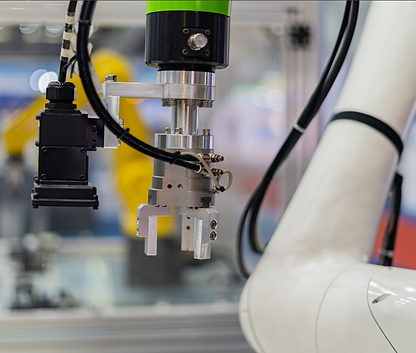
Surface defects, missing features, contamination, and damage can be difficult to catch consistently when hundreds of parts need to be checked throughout a shift. Automated visual inspection uses cameras and machine vision to check each part against defined inspection criteria, helping identify defects before they move further downstream. A robot can present the part to a fixed camera or move the camera around the part, making it possible to inspect multiple surfaces, angles, and features within the same automated process. Manufacturers get more consistent defect detection without tying an operator to repetitive visual checks throughout the shift.
Dimensional Inspection, Measurement & Gauging
Tight tolerances depend on accurate, repeatable measurement throughout production. Robotic dimensional inspection can present parts to gauges and measurement stations or position laser sensors and 3D scanners around the part to check dimensions, tolerances, and geometry. Measurements can also be recorded automatically, reducing manual inspection and data entry while helping manufacturers catch out-of-tolerance parts before more time and material are invested in them.
Surface Inspection
Scratches, coating defects, finish inconsistencies, and other surface flaws aren't always visible from a single angle or under the same lighting. Automated surface inspection can use controlled lighting and machine vision to examine a part from multiple positions and identify defects before the part moves downstream or ships. That gives manufacturers a more repeatable way to verify surface quality while reducing the risk of defects reaching the customerIt's also a natural complement to automated sanding, polishing, and other surface finishing processes, providing a way to inspect the finished result.
Assembly Inspection & Verification
A missing component, incorrect orientation, or improperly installed part is much easier to correct before an assembly moves further down the line. Automated assembly inspection can verify part presence, position, orientation, and other defined requirements for each unit. This is especially useful for high-mix production where operators may be working across multiple product configurations and variations, helping catch assembly errors earlier without adding another repetitive manual inspection step.
In-Line Inspection During Machine Tending
When a robot is already loading and unloading a machine, inspection can often be incorporated into the automated cycle as well. After removing a finished part, the robot can present it to a camera, gauge, or measurement system for an in-line inspection before the part moves to the next operation. This keeps quality control close to the machining process, helping manufacturers catch problems sooner, reduce downstream scrap and rework, and get more value from an automation system that's already handling the part.
One System, Every Check
A single inspection cell can support visual, dimensional, surface, and assembly checks across your parts. Cameras, sensors, and inspection criteria can be swapped within the same cobot, so you can automate more than one type of check without deploying a separate system for each.
Is Inspection Automation Right for Your Operation?
Best Fit When:
May Be More Challenging When:
You can clearly define what a good part looks like, with specific defect standards, tolerances, or pass/fail criteria.
Manual inspection has become a bottleneck, produces inconsistent results, or is difficult to keep staffed.
Parts need to be inspected from multiple angles, sides, or positions.
You run multiple shifts and want the same inspection standards applied consistently throughout production.
Inspection relies heavily on nuanced human judgment rather than clearly defined, repeatable criteria.
Required measurement precision exceeds what a robot-positioned camera, sensor, or gauge can reliably achieve.
Production volumes are too low or unpredictable to justify the cost of a dedicated inspection cell.
Robotic Machine Vision & Inspection Technology
Machine vision is a key part of automated inspection systems, combining cameras, sensors, lighting, and software to inspect parts against defined quality standards. Cobot Team integrates this technology with the robot and other equipment needed to build a complete quality control automation system, rather than treating vision as a standalone component.
A vision inspection system can be mounted to the robot for flexible positioning, allowing the camera to inspect different sides, angles, and features of a part. In other applications, the camera remains fixed while the robot presents each part in a consistent position for inspection. The right approach depends on the part, what needs to be inspected, and the level of precision required. Either way, manufacturers gain a more flexible inspection process that can check multiple features consistently without relying on a separate manual inspection at each step.

Inspection results can also be integrated with the rest of the automation system, allowing failed parts to be rejected or routed for rework and inspection data to be recorded automatically. This helps manufacturers catch quality problems sooner, reduce manual handling and recordkeeping, and build better traceability into the production process.
Collaborative Robotic Inspection Platforms
Cobot Team builds robotic inspection and quality control systems using FANUC CRX and Dobot CRA collaborative robots. Both platforms can integrate machine vision systems into the inspection process, with flexible options for camera placement, part handling, and communication with other production equipment. The right platform depends on your parts, inspection requirements, reach, payload, and the equipment the robot needs to work with.


Dobot CRA
Dobot CRA cobots pair with smart cameras for a streamlined machine vision setup designed for fast deployment and easy integration with other production equipment.

Why Choose Cobot Team?
An Automation Partner, Not Just a Robot Supplier
Whether you're automating a single inspection step or building a complete quality control cell, Cobot Team provides the integration expertise and ongoing support to help you move forward with confidence.
Strategic, Phased Approach
Start with one inspection step or part family, prove the results, and expand inspection automation at a pace that makes sense for your operation.
Long-Term Support
From programming and training to technical support and service, our team helps keep your inspection automation performing long after installation.

FANUC Integrator
As a FANUC Authorized Integrator, Cobot Team can source, integrate, and support robotic inspection systems built on the FANUC CRX cobot line, including FANUC iRVision machine vision technology.
Application Focused Solutions
We evaluate your parts, defect standards, and inspection requirements to recommend the right camera, sensor, robot, and machine vision configuration for the application.
Nationwide Support
Headquartered in Portland, Oregon, Cobot Team supports manufacturers across the United States with remote and on-site automation support.

Dobot Integrator
Cobot Team sources, integrates, and supports inspection systems built on Dobot's CRA cobot line, including the VX500 smart camera for plug-and-play vision inspection.
